Fear not, the raccoon wars rage on.
I was sure the large flower-pot-type unit over the duck food can was the answer. It worked for three days. I guess in terms of raccoon wars, that's a long time. But in terms of keeping the cost of feeding the ducks at a reasonable level, it's not long enough.
So, back to the drawing board. OK. They can unhook bungee cords. Those they cannont unhook, they just eat. They can knock a decent-sized rock off the top of the can. They can certainly remove a simple lid, and it took them only three nights to figure out how to remove a wedged-on, very large plastic pot from the top of the container. Hmmm. Even I couldn't get that danged pot off without lifting the entire, twenty-plus-pound contraption, food and all, and banging it down several times.
At this point, I just refuse to put the food in the basement. It's not that I don't think that's a good idea, I just can't admit an animal with a brain one-twenty-fifth the size of mine can outsmart me. My pride just won't allow it.
Now I think I've really, really got it. I located one of the many pavers that were used around here and that we laboriously dragged from hillside and garden to the side of the house for future use. Like to keep raccoons out of the duck food. Those babies must weight thirty pounds themselves. Maybe more.
Great. So I picked one up, huffing and puffing it down the steps, across the lawn, back up to the porch, and finally on top of that pesky food storage can. Boy, that should do it.
And it has. For three nights, now.
Sunday, May 28, 2006

Saturday, May 27, 2006
Perseverance
It has been quite a year for lilacs. The ones in the parking lot island have finished their blooming and are now lush in their summer greens. I guess the long, cold, snowy winter was just the ticket for lilacs (and a lot of other plants, by the look of things around here). But the poor bush I yanked unceremoniously out of the ground last fall isn't faring quite as well.
I decided this plant was in the wrong place, snuggled up in the corner by the kitchen porch—not enough sun, too much wind, and stiff competition from the forsythia. So I moved it about fifteen feet west, where it could get good sun, now that ten of the twelve hemlocks once crammed into that space are gone. And when the chapel doors stand open in the summer, it would provide a lovely view. So with about half an hour to kill one afternoon, I tackled the move.
Wrong plan.
Lilac root balls are impressively large and deeply buried. Once committed, I had to get the job done, so I just got what I could of the root ball, dug the deepest hole possible (not nearly deep enough), in the remaining few minutes I had, and hoped for the best.
When this bush budded out with her parking lot neighbors in January, I was thrilled. She had made it! What stamina. But in April, when the rest of the crew was bursting with color and perfume, this little one just sat there with the same tiny buds she had produced months earlier. Uh-oh.
Every day I visited her, made sure she had enough water, checked her limbs for any sign of life, sang to her and convinced myself that there was suppleness just under my fingertips. Let's give her another week before pronouncing her past hope. Every day when I examined the little buds, I told myself something was happening there. Truth to tell, I just couldn't face the fact the I may have killed this little bush myself. Please, God, don't let me be a murderer this late in my life.
Then, a few weeks ago, there it was, the proof I had been watching and praying for all that time. No doubt about it now, there was green appearing at the bud tips. Oh, wow; we both had been reprieved.
But a few days later, I got a bigger surprise. This bush hadn't flowered in the three years since I moved here, so I assumed moving it would mean no blooms for several years more.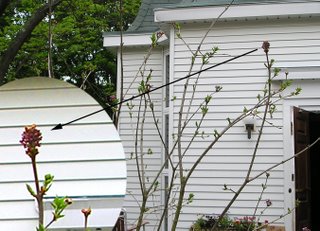 But there, right at the tip of about half the branches, were tiny blooms!
She may be nearly half a year behind her sibs across the driveway, and she may look puny to other folk, but to me she's simply gorgeous. You can be sure I spend time with her every day, still watering, and touching, and speaking words of praise to her.
She has become one of my teachers. Hang in there, no matter how hopeless you feel, she says. If you're yanked out of your comfortable home, leaving most of your roots behind, just sit tight in your new digs. New life may appear when you least expect it, and it will be all the sweeter for the surprise of it. Rough treatment certainly is no picnic, but you may find out you are tougher than you think. And don't worry too much if your neighbors seem to be more beautiful than you are; there is someone in the world who will love you to pieces, just the way you are.
I decided this plant was in the wrong place, snuggled up in the corner by the kitchen porch—not enough sun, too much wind, and stiff competition from the forsythia. So I moved it about fifteen feet west, where it could get good sun, now that ten of the twelve hemlocks once crammed into that space are gone. And when the chapel doors stand open in the summer, it would provide a lovely view. So with about half an hour to kill one afternoon, I tackled the move.
Wrong plan.
Lilac root balls are impressively large and deeply buried. Once committed, I had to get the job done, so I just got what I could of the root ball, dug the deepest hole possible (not nearly deep enough), in the remaining few minutes I had, and hoped for the best.
When this bush budded out with her parking lot neighbors in January, I was thrilled. She had made it! What stamina. But in April, when the rest of the crew was bursting with color and perfume, this little one just sat there with the same tiny buds she had produced months earlier. Uh-oh.
Every day I visited her, made sure she had enough water, checked her limbs for any sign of life, sang to her and convinced myself that there was suppleness just under my fingertips. Let's give her another week before pronouncing her past hope. Every day when I examined the little buds, I told myself something was happening there. Truth to tell, I just couldn't face the fact the I may have killed this little bush myself. Please, God, don't let me be a murderer this late in my life.
Then, a few weeks ago, there it was, the proof I had been watching and praying for all that time. No doubt about it now, there was green appearing at the bud tips. Oh, wow; we both had been reprieved.
But a few days later, I got a bigger surprise. This bush hadn't flowered in the three years since I moved here, so I assumed moving it would mean no blooms for several years more.
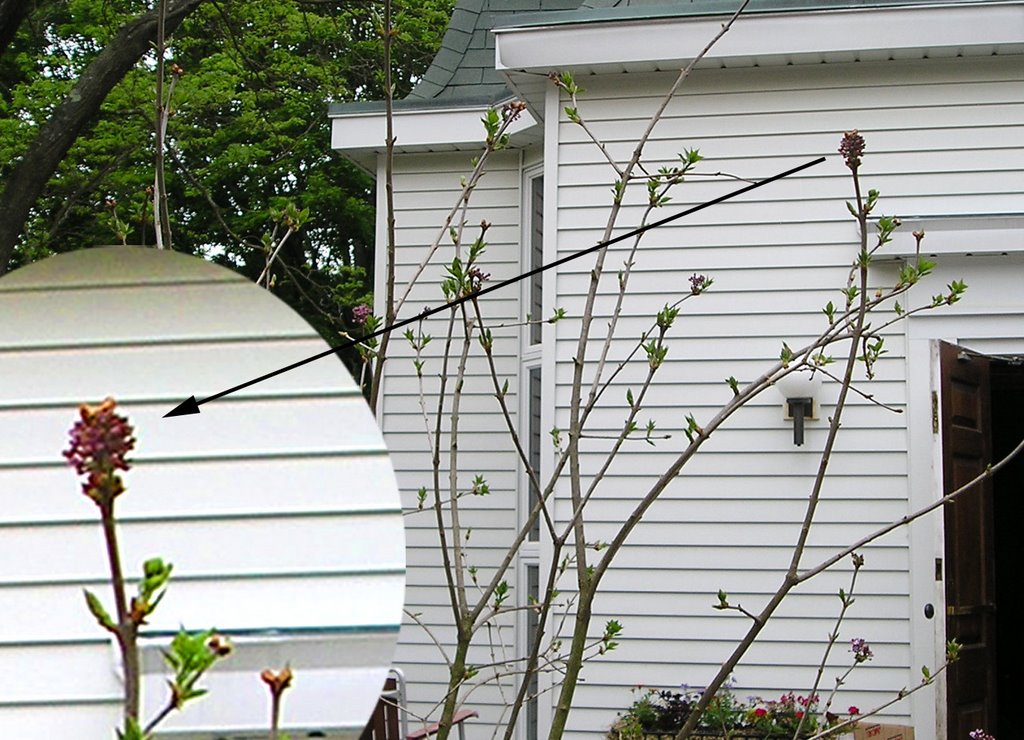 But there, right at the tip of about half the branches, were tiny blooms!
She may be nearly half a year behind her sibs across the driveway, and she may look puny to other folk, but to me she's simply gorgeous. You can be sure I spend time with her every day, still watering, and touching, and speaking words of praise to her.
She has become one of my teachers. Hang in there, no matter how hopeless you feel, she says. If you're yanked out of your comfortable home, leaving most of your roots behind, just sit tight in your new digs. New life may appear when you least expect it, and it will be all the sweeter for the surprise of it. Rough treatment certainly is no picnic, but you may find out you are tougher than you think. And don't worry too much if your neighbors seem to be more beautiful than you are; there is someone in the world who will love you to pieces, just the way you are.
Monday, May 22, 2006
Things Change
From days of rain to a day so clear your eyes hurt. Well, that's weather for you. I don't know why I fuss when things like weather appear to get stuck with the needle pointing to "lousy". In the first place, that's a pretty lopsided judgment to make—that rain is lousy and sunshine is wonderful. Actually, I love and appreciate them both, so what gives?
I think some needle deep inside me hangs up occasionally, pointing at lousy. Then I just look around and blame it on the nearest possibility. Like the weather.
But things are changing all the time, and if I could just unstick my own internal value monitor, I could avoid that gray, nasty, hopeless feeling that this (whatever "this" happens to be at the time) is just the way life will be forever. OK, maybe only for the foreseeable future, but when this happens, I'm not appreciating such distinctions.
Maybe I could remember this, instead: I went out to the rocky area beside the kitchen garden about a week ago to see how the new weed crop was going. That would be dandelions, plantain, wild violets, a few little ground-crawlers I haven't met yet, and some big dude that sports deep purple leaves all summer. That one was so pretty I actually watered it all last year, right along with the herbs.
But when I got out there, the only returners were the dandelions and violets. Where the little ground cover and plantain once shoved rocks aside were plants I've never seen there before. There are two huge docks, for example (a large critter that looks a lot like rhubard early on). And a bunch of smaller greenies; I have no idea at all what they are. The big purple dude? No sign of him yet, but there's nothing in his place, so I'm still hoping.
 Then I started checking father afield. The front "yard", the back meadow, the hill from the driveway to the playing field; they are all home to plants that weren't there last year, at least not the way they are this. Wild chives and wild onions are really popular (we eat both). It's back to my plant book again to find out who else has joined the Bluestone Farm family.
Yep. Things are changing all the time. Enjoy whatever is under my nose right now, because sooner or later it will surely change. I just need to remember that.
I think some needle deep inside me hangs up occasionally, pointing at lousy. Then I just look around and blame it on the nearest possibility. Like the weather.
But things are changing all the time, and if I could just unstick my own internal value monitor, I could avoid that gray, nasty, hopeless feeling that this (whatever "this" happens to be at the time) is just the way life will be forever. OK, maybe only for the foreseeable future, but when this happens, I'm not appreciating such distinctions.
Maybe I could remember this, instead: I went out to the rocky area beside the kitchen garden about a week ago to see how the new weed crop was going. That would be dandelions, plantain, wild violets, a few little ground-crawlers I haven't met yet, and some big dude that sports deep purple leaves all summer. That one was so pretty I actually watered it all last year, right along with the herbs.
But when I got out there, the only returners were the dandelions and violets. Where the little ground cover and plantain once shoved rocks aside were plants I've never seen there before. There are two huge docks, for example (a large critter that looks a lot like rhubard early on). And a bunch of smaller greenies; I have no idea at all what they are. The big purple dude? No sign of him yet, but there's nothing in his place, so I'm still hoping.
 Then I started checking father afield. The front "yard", the back meadow, the hill from the driveway to the playing field; they are all home to plants that weren't there last year, at least not the way they are this. Wild chives and wild onions are really popular (we eat both). It's back to my plant book again to find out who else has joined the Bluestone Farm family.
Yep. Things are changing all the time. Enjoy whatever is under my nose right now, because sooner or later it will surely change. I just need to remember that.
Friday, May 19, 2006
Raining again
 It's pouring rain again today, so I just have to put some sunny photos under my nose. Here we have yet another view of the woods with the morning sun. I find our woods enchanting. Fairy tales were written with such views in mind.

And then we have ... potato plants!! Last year it seemed to be in late June or early July before these plants made their appearance, but here it is, mid-May, and voila, potato wannabes.
No preachy lesson this time. Just a chance to share in the beauty of the Farm.
Got real milk?

I was less than happy to see this sticker on a recent raw milk purchase. This is the result of our powerful dairy lobby, hard at work.
The message appears to be offered in the spirit of health-consciousness, but it is actually there in the interest of business. As in huge agri-business, factory farming, petroleum-dependent food production. The motive here is profit, not protection.
The truth is that raw milk is loaded with goodies that are beneficial to mammalian bodies. If you're not allergic to milk and want to drink it, raw's the way to go. Why? Because milk (obtained from grass-fed cows), when it has been properly gathered and safely stored and transported, is quite healthy. For example, some of the enzymes that raw milk contains actually assist the body in processing the fat in the milk. And the fat itself is healthy. If you're interested in the truth about raw milk, take a look at this brochure, produced for the Campaign for Real Milk (Weston A. Price Foundation, Washington, DC). Here's just one sentence from that brochure that should set you to thinking:
"Pasteurization destroys enzymes, diminishes vitamin content, denatures fragile milk proteins, destroys vitamins C, B12 and B6, kills beneficial bacteria, promotes pathogens and is associated with allergies, increased tooth decay, colic in infants, growth problems in children, osteoporosis, arthritis, heart disease and cancer."Sr. Claire Joy remarked this morning that pasteurization is like chemotherapy. I started to laugh, then we suddenly realized that it is chemotherapy. The process is violent (milk is quickly heated, especially in ultra-pasteurization, which takes less than two seconds) and destroys all the friendly, healthy contents as well as the rare bad booger in its path.
Then more chemistry is applied: scary-sounding stuff like oxidized cholesterol, neurotoxic amino acids, mucopolysaccharides, colorings, and bioengineered enzymes ... none of which even touch the antibiotics, hormones and pesticides that find their way into a cow's body, all in the name of increased milk production. The treatment of high-production animals, the destruction of small farms and farmers, and the dangers of genetically-engineered additives are each rich fodder for an entire blog of its own.
Yes, this is definitely a preachy entry, and for that I apologize. But I'm willing to take on just about any epithet if it helps awaken even one person to the dangerous "food" that lines our grocery store shelves, and to spurious marketing ploys that promise us health but give us junk.
Subscribe to:
Posts (Atom)


