Saturday, March 11, 2006

When the conditions are right


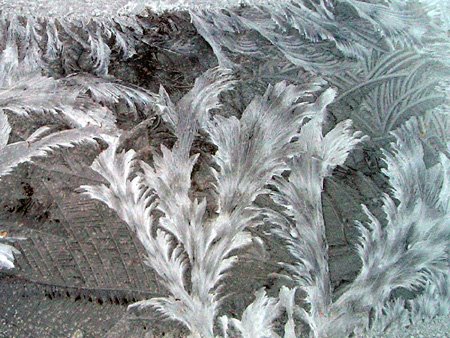
We have cold frames in the garden again this year. Two of them seem prone to creating incredible works of art. When all the conditions are just right, frost forms on the glass. This is just one of the beautiful images that appeared this winter.
Friday, March 10, 2006

What season is it, anyway?

I'm sitting here, 10:30 at night, scratching a mosquito bite. I know that sounds prosaic, but when you're munched on by a "skeeto" in early March, that's a bit odd. After all, there's still snow on the ground (OK it's just a dab, but it's there); we were shoveling more than two feet of snow just a month ago, and as of yesterday we only went outside bundled up like ten-year-olds out for a day of January sledding. So what was that little bomber doing awake at this time of year?

And s/he wasn't alone in early rising. I sent a small troup of slab ants to their greater reward in the kitchen this afternoon, along with a good-sized spider (which I'm loathe to kill; but she wouldn't have fared too well outside, either). Just because it was unseasonably warm today (an amazing 70°), that's no reason for insects to jump the gun and haul themselves out of hiding and into the world at large. It's not a very workable plan. Come Tuesday and the return of respectable March weather, they'll pay a dear price for their premature appearance.

This is sugaring season, when temperatures usually run below freezing overnight and into the low 40's during the day. Those are the ideal conditions for our maple trees' sap to roar up from the rich Earth, zooming skyward through the sapwood in the morning, then reversing direction and falling back to Earth at night. The sun plays a big role, too. When the high branches sense the sun's climb up from the southern sky, they holler down to the roots that it's time to draw up the lifeblood, stirring the tree's first yawns and stretches from a long winter's nap.

It's possible that this little warm spell might trigger the maple tree's full awakening; when a tree leaves dormancy, buds will begin to appear. During that phase, the sap changes from crystal clear to a brown-ish yellow. It's no longer ideal for making syrup, taking on a darker color and a "buddiness" to the taste. And that's when we cease our busy sugaring operation, finishing off whatever sap is in storage, labeling the last of the bottles, washing the pans one last time ...

We're all on a cusp. It's not exactly winter. But it's not exactly spring, either. Should I sleep or get up? Stop making syrup or keep going? Make buds? Crawl out of whatever hidey-hole protects a brave little mosquito and venture into the daylight? We don't know. None of us. We just make our decisions as we go, some great, some dangerous, some ridiculous, some brilliant.

This time may be hard to navigate, but it's also loaded with wonder and surprise. Everything is hovering between the was and the will-be, death and new life. Maybe we should call this in-between time "sprinter". Or maybe we should call it Lent.

Thursday, February 02, 2006

Bruno, the King of Melrose

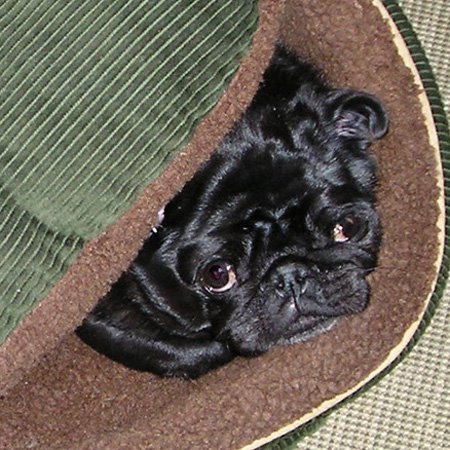
A few times a year we are blessed with a vist from a little four-legged God-spark named Bruno—a cuddly black dynamo (otherwise known as a Pug) of affection and entertainment. He sits respectfully in his own chapel seat throughout offices and Mass, and when we leave he bounces along he path beside me as we return to the house.

Because his head is only about a foot off the floor, he prefers laps, chairs and beds to the isolation of the floor. He doesn't enjoy the company of ankles as much as that of hands and arms and faces ... and the occasional peek at the dinner table when he can arrange it. Right now he's snuggled in the crook of my arm as I type this, snoring softly. This is a little too early for him, so he's finishing up on last night's beauty sleep.

He's a charming creature of routine, yet he is quite tolerant when things don't go exactly as he planned. Early with breakfast? Late with the afternoon walk? No problem. The only exception to his amazing adaptability is the evening treat, which is timed roughly in the middle of meditation. He is usually snuggled in my lap, sound asleep, when his internal snack-alarm goes off. His little eyes pop open, he jumps down and runs to the table where I keep ... not the snacks, but the cleaning pads used to keep the folds of his nose healthy. The drill is clean the nose, eat the treat, and he knows it. The nose routine is only every other day though, and in his usual display of flexibility, he gladly forgoes that part, as long as that tasty sausage thing gets into his mouth. Mmmmm.

He and Simon are quite the pair: large taupe racer and mini black snugglebug. Simon's still not quite sure if Bruno is safe, so, Beta dog that he is, Simon gives way to Bruno. The seven-pound King rules over a seventy-five pound dog. But he is a gracious sovereign, and other than taking over Simon's huge bed, Bruno pretty much ignores the Big Brown Dog.

As you can probably tell, Bruno captivated my heart long ago. I spoil him rotten, preferring him on my lap whenever possible. I'm great with food control; I know how easily humans can harm their animal companions with love in the form of food—that's how we treat ourselves, after all. But when it comes to petting, holding and all-around loving, I have no control.

There is something wildly alluring about the unconditional love manifested in many of our non-human friends. Wouldn't life be grand if we two-leggeds treated each other with the same kind of "stringless" affection?

Saturday, January 21, 2006

Western Sunrise

I was trying to capture the Earth's shadow this morning; it was a perfect sunrise for it. I knew the shadow would have disappeared by the time I made it outside with the camera, so this is what I saw from my window. The shadow is the faintly darker, grayish area just at the horizon to the left of the chapel roof. OK, you'll just have to trust me. It was there.

This was one of those rare mornings when the western sunrise sky is more striking than the eastern. I sat in my rocking chair, watching the sky change as our side of the Earth rolled toward the sun behind me.

Watching the sunrise toward the west is actually watching the night fade away. When the atmospheric conditions are just right, the last little bit of departing night I can see is the changing angle of Earth's shadow. It becomes more obvious and darker for a few moments, and then the new-day light chases it over the horizon and out of sight.

For eons we've referred to the Earth's spinning journey as the "activity" of the sun — sunrise and sunset. This is not only logical — it does appear that the sun travels around us and not the other way around — but it is our wonderful, life-giving local star that is the source and sustenance of all Earth life. On the other hand, I love the idea of using language to reawaken a sense of awe and wonder about our amazing planetary home. So how about these: nightset and nightrise. Or maybe Earthdrop and Earthroll.

Hmmm. Well, it was a thought. Posted by Picasa

Friday, January 20, 2006

And the beat goes on


The pear tree isn't the only storm casualty on the farm, though these remnants of a horse chestnut were created several years ago. But the Earth's wisdom in using absolutely everything is wonderfully obvious here. The "dead" piece of trunk is home to millions of little creatures and plants, some working to transform the wood into soil — and they'll get the job done, too, never mind how long it takes from a human point of view.

When Lent arrives we will be singing the haunting refrain "In the midst of life, we are in death ... " during Compline, the last, quiet service of the day. And here, right under our noses, the Earth is singing its hopeful counterpoint: "In the midst of death, we are in life ..."