In some ways, summer is almost too intense to bear. The garden swiftly shifts from slow, little sprouts to raging, bulging harvest. Bringing in this abundance, cooking, trying to stay one step ahead of the fierce weed crop, replacing the hot water tank and the entire house-full of plumbing pipes, welcoming a new headmaster to the school ... it's all a challenge, and most of it is good.
Most of it. I could do without the hot water and plumbing thingies.
So what is the latest blip on my radar screen? Spinning. Yep, I've got the spinning bug. It may be worse than Erlichiosis (a particularly nasty tick-born disease) or even cellulitis (I've already logged my annual event). A good friend gave us some wool roving and two makeshift drop spindles, and a few days later I'm history. I've already ordered my first Kundert spindle (is there possibly any better?), and taken apart my first efforts so I could keep spinnng something—anything.
Including the dog's hair. Not just any dog, or even our dog, mind you — I used the hair of the adorable little poodle entrusted to our care by our summer intern (and fabulous blessing herself). It's entirely possible; You can actually spin dog hair. Is that amazing, or what?
Now I have my eye on Smooch, our long-haired cat.
I love all kinds of handwork—knitting, crocheting, sewing, quilting ... but this spinning business is a life unto itself. I'm a nun, and probably shouldn't be using this language, but it feels like a calling. I think I could spin all day, every day, and never be bored.
Jeez, that's scary.
I'm trying to figure out how this passion might be useful to our community. Can I learn to do it really, really well? Maybe experiment with natural dyes? Sell the stuff?
I don't know those answers yet, but I do know what it feels like to discover one of the passions we are each (yes, every one of us) endowed with when we appear on this planet. It sings you. It dances your body. It delights your heart in a thousand ways. You would give up food, sleep, maybe even sex, just so you could do it some more. That's passion, my friends.
And if each of us could connect with one or two (or, God help us, three) of those gifts, what an incredible world this would be.
Monday, July 31, 2006

Monday, June 05, 2006
Justice ... for whom?
One of our dear friends had a horrific experience last week, and it breaks my heart. She was riding her bike in a peaceful demonstration with the group called Critical Mass, a movement that promotes bicycle-riding as one solution to the rapidly dwindling availability of petroleum products, and our rather scary dependence on Earth's oil resource.
Apparently a row of police cars appeared and blocked a cross-street in front of the riders. They slowed down, and as our friend passed by one of the cars, the door flew open, knocking her off her bike. As she fell, her shoulder was broken. The officer who did this is claiming it was her fault. He did come to the hospital—not to see how she was, but to give her five tickets amounting to $150.
This is tricky. No one can prove whose fault this "accident" was, though witnesses believe the door was opened both violently and with purpose. But that's a tough thing to prove, and in our litigious environment, suing a police department has a pretty small chance of succeeding. At least, that's what the lawyer is telling her and I suspect it's right.
On the other hand, paying the tickets is tantamount to admitting guilt, strengthening the police claim to innocence. With the medical costs, the interruption to both her work and personal life, and the physical pain, to say nothing of the injustice of it all, such an act goes against the grain. I ache for her. She's been going through a rough patch in life, and this is the last thing she needs. She's a good and holy woman, who wants to participate in creating a better world for us all.
Here's what breaks my heart: we are a country crumbling under the weight of our consumer worldview and excessive lifestyles. Many of our police departments (along with churches, businesses and educational institutions, among others) are struggling to right themselves from reputations besmirched by members who have forgotten who they are and what (hopefully) led them to these occupations in the first place.
What has happened in that officer's professional and personal life that opened the door to such a cruel, needless, unfair act against someone he doesn't even know? And what continues to exist in our organizations that promotes the cooperation and tacit approval of their colleagues and superiors in such behavior? The Enron debacle has shown us how pernicious is the spread of participation in illegal, unethical, immoral behavior. And we are all cohorts in these crimes if we simply sit back and tsk-tsk about them, doing nothing to change our world.
"Terrorism" isn't a person we can shoot or a place we can bomb. It is a willingness in the heart to abandon self-respect, to forget that when we hurt anything else on Earth we hurt ourselves as well, to lose track of what it means to be a species capable of (and responsible for) compassionate behavior. The possibility for being a terrorist lives in every one of us; whether we act it out or not is a choice we must each make.
It breaks my heart that a people founded on, and quick to claim, the high ideal of "freedom and justice for all" has become the laughingstock of the world. Sadly, we continue to earn those snorts and snickers.
Apparently a row of police cars appeared and blocked a cross-street in front of the riders. They slowed down, and as our friend passed by one of the cars, the door flew open, knocking her off her bike. As she fell, her shoulder was broken. The officer who did this is claiming it was her fault. He did come to the hospital—not to see how she was, but to give her five tickets amounting to $150.
This is tricky. No one can prove whose fault this "accident" was, though witnesses believe the door was opened both violently and with purpose. But that's a tough thing to prove, and in our litigious environment, suing a police department has a pretty small chance of succeeding. At least, that's what the lawyer is telling her and I suspect it's right.
On the other hand, paying the tickets is tantamount to admitting guilt, strengthening the police claim to innocence. With the medical costs, the interruption to both her work and personal life, and the physical pain, to say nothing of the injustice of it all, such an act goes against the grain. I ache for her. She's been going through a rough patch in life, and this is the last thing she needs. She's a good and holy woman, who wants to participate in creating a better world for us all.
Here's what breaks my heart: we are a country crumbling under the weight of our consumer worldview and excessive lifestyles. Many of our police departments (along with churches, businesses and educational institutions, among others) are struggling to right themselves from reputations besmirched by members who have forgotten who they are and what (hopefully) led them to these occupations in the first place.
What has happened in that officer's professional and personal life that opened the door to such a cruel, needless, unfair act against someone he doesn't even know? And what continues to exist in our organizations that promotes the cooperation and tacit approval of their colleagues and superiors in such behavior? The Enron debacle has shown us how pernicious is the spread of participation in illegal, unethical, immoral behavior. And we are all cohorts in these crimes if we simply sit back and tsk-tsk about them, doing nothing to change our world.
"Terrorism" isn't a person we can shoot or a place we can bomb. It is a willingness in the heart to abandon self-respect, to forget that when we hurt anything else on Earth we hurt ourselves as well, to lose track of what it means to be a species capable of (and responsible for) compassionate behavior. The possibility for being a terrorist lives in every one of us; whether we act it out or not is a choice we must each make.
It breaks my heart that a people founded on, and quick to claim, the high ideal of "freedom and justice for all" has become the laughingstock of the world. Sadly, we continue to earn those snorts and snickers.
Sunday, June 04, 2006
Marie Shirer: Quilter, Priest, Friend Extraordinaire
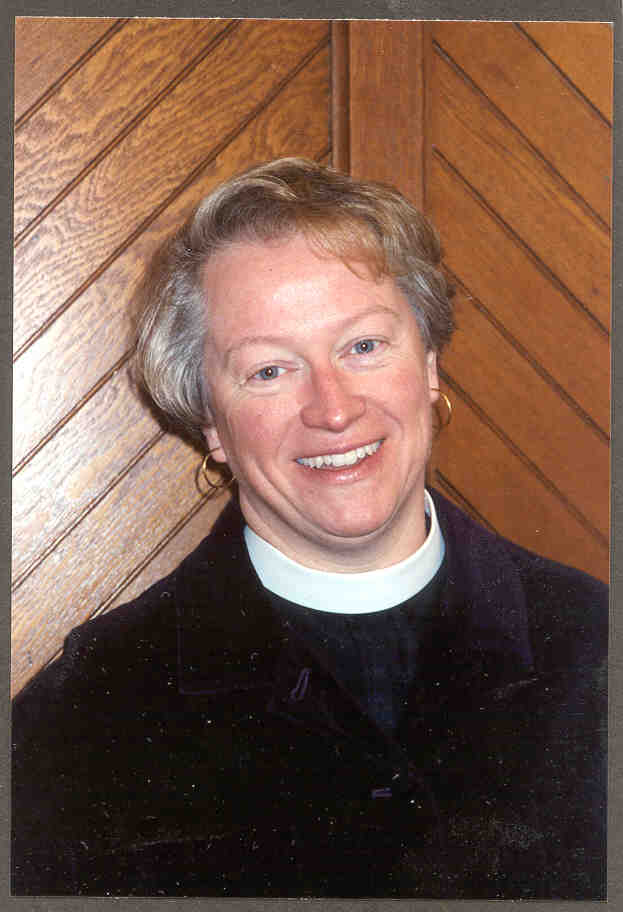 June 4, 2002.
She slipped away in the middle of the night, as many people do. We, her friends, family and colleagues had been sitting vigil with her for six weeks as she surrendered her Earthly life to the ravages of cancer.
We laughed and questioned and cried. We suffered and we celebrated. On this morning four years ago, we gathered one last time in her hospice room to say our final goodbyes. It was freezing in there—the hospice's attempt to preserve her body and keep the environment as safe as possible. But her room was always cold; she suffered terribly from "tumor sweats", so the rest of us wore sweaters and shawls and even used an extra blanket once in awhile to tuck around our shoulders or feet.
Marie's departure from us was an anguish, of course, and on this anniversary I find myself crying over the loss of her wild and wonderful presence as if it had happened yesterday. I miss her terribly.
And yet those days of her dying wove a holy coccoon of transformation around us all. She faced her death with the same honesty, humor, and intensity that characterized her whole, brief life. Whether she was designing a new quilt, challenging a seminary professor, entertaining her Colorado friends over a traditional Swedish Christmas dinner in her Arvada home, playing with her adorable Corgis, or sitting with a grieving family, Marie gave her entire being to the task of living.
Margaret Guenther called me at the convent to tell me that the investigation into Marie's troublesome cold had revealed a much more serious problem: stage IV liver cancer. As Marie quickly added to the diagnosis, "There is no Stage V." Everyone knew the remaining few weeks for her wouldn't include chemotherapy or radiation or any other attempt to delay her inevitable death. They would be filled instead with finding her a comfortable place to die and providing relief from her pain. (I can't say enough about Washington Home and Hospice; my sisters are going to have to cart me down there if I wind up in similar circumstances.)
Those short weeks were also filled with an amazing group of women who surrounded Marie and quickly learned to love each other with a depth that awed us all. Not one of us escaped Marie's challenge to engage in this dying as sister, comforter, companion of the heart. The day I arrived, she looked me in the eye (a classic Marie glare), and said, "OK, Sister. What really happens after death?" And she wanted a meaty answer, nothing that even hinted at platitude. Whew; I knew immediately the days ahead would prove to be an adventure typical—and worthy—of Marie.
No matter how awful a situation could be, Marie would occasionally find a way to lighten things up. She understood the healing power of humor better than anyone else I ever met. One day we suggested wheeling her bed her out to the patio to enjoy the warm sun. This was one of the first days that she knew she would never leave that bed. She was in a crabby mood, and we thought the change might ease her frustration. Suddenly she sat up, grabbed the bed railings and pasted a wild look of glee on her face. She made racing noises and rocked back and forth, just like a little boy in a pretend race car. We all burst out laughing; her Barney Oldfield impersonation had evaporated the building tension.
In late May, as I sat beside her shivering in the cold while she soaked her bed with sweat, she told me that the dying process was really boring. Our long, wonderful relationship allowed me to tell her I was finding it boring, too. I had knit enough scarves to outfit the entire crew of an oil tanker, and she could no longer engage in a book, TV or a long conversation. And we were both tired of the cruelty of cancer.
Near the end, Marie began to shift into dream-language; we often think a dying person is just "out of her head", but I believe that the same symbolism used by our dreams crosses over into our more wakeful moments, communicating important information. Days before she died, Marie awoke from one of her lengthening naps and said to me, "Sister, let's just get out of here, get in the car and head for the airport."
I hesitated as I thought about what she might be "processing" internally. Clearly her conversations had increasingly reflected a desire to move on. As I sat there she added, "But you would lose your parking space, wouldn't you?"
"Ah, yes," I finally said. "And I'm not really ready to give up my parking space yet." Marie closed her eyes, a small smile playing at the corners of her mouth.
My last moments with Marie's body were incredibly healing. She had died with that same small smile tickling her face, and it was still there three hours later. I sat with her body as it traveled its own journey into the future, and was awed to realize that bodies don't "just stop"—they have a job to do and they do it with an elegance and beauty that stunned me. It was the opening of my own healing process.
On June 8, a large group gathered at her beloved St. Columba's Church to grieve her death and celebrate her life, and we did both. Margaret wrote the following prayer for that occasion, and I find comfort in it today as I did in those first moments when I realized that I would spend the rest of my own life without the challenging, joyful presence of my dear friend.
Loving, gracious God,Creator, Mother, Father, Look upon this weave of women! Mothers, daughters, sisters, friends; Woven together in love of you and in love of our sister Marie. Artist, creator, seamstress God, Gifted, ingenious user of scraps and pieces, big and little, look upon this patchwork quilt of women's lives, unfinished, filled with color, filled with light and filled with darkness, moving toward wholeness and stitched together in the intricate loveliness of your quilting.Marie, my dear friend, may you rest in the arms of the angels of Light. I'm sure you are entertaining them with your eternal, lively wit; may nothing ever bore you again.
Help us to be midwives. Help us to reflect your tender mother love. Help us to be fully present to the wonder of your presence. We offer you our thanksgivings. We offer you our hopes. We offer you our prayers. Help us to remember that this circle is and will be unbroken. Help us to remember that we are bound together in your love.
Sunday, May 28, 2006
News from the Front
Fear not, the raccoon wars rage on.
I was sure the large flower-pot-type unit over the duck food can was the answer. It worked for three days. I guess in terms of raccoon wars, that's a long time. But in terms of keeping the cost of feeding the ducks at a reasonable level, it's not long enough.
So, back to the drawing board. OK. They can unhook bungee cords. Those they cannont unhook, they just eat. They can knock a decent-sized rock off the top of the can. They can certainly remove a simple lid, and it took them only three nights to figure out how to remove a wedged-on, very large plastic pot from the top of the container. Hmmm. Even I couldn't get that danged pot off without lifting the entire, twenty-plus-pound contraption, food and all, and banging it down several times.
At this point, I just refuse to put the food in the basement. It's not that I don't think that's a good idea, I just can't admit an animal with a brain one-twenty-fifth the size of mine can outsmart me. My pride just won't allow it.
Now I think I've really, really got it. I located one of the many pavers that were used around here and that we laboriously dragged from hillside and garden to the side of the house for future use. Like to keep raccoons out of the duck food. Those babies must weight thirty pounds themselves. Maybe more.
Great. So I picked one up, huffing and puffing it down the steps, across the lawn, back up to the porch, and finally on top of that pesky food storage can. Boy, that should do it.
And it has. For three nights, now.
I was sure the large flower-pot-type unit over the duck food can was the answer. It worked for three days. I guess in terms of raccoon wars, that's a long time. But in terms of keeping the cost of feeding the ducks at a reasonable level, it's not long enough.
So, back to the drawing board. OK. They can unhook bungee cords. Those they cannont unhook, they just eat. They can knock a decent-sized rock off the top of the can. They can certainly remove a simple lid, and it took them only three nights to figure out how to remove a wedged-on, very large plastic pot from the top of the container. Hmmm. Even I couldn't get that danged pot off without lifting the entire, twenty-plus-pound contraption, food and all, and banging it down several times.
At this point, I just refuse to put the food in the basement. It's not that I don't think that's a good idea, I just can't admit an animal with a brain one-twenty-fifth the size of mine can outsmart me. My pride just won't allow it.
Now I think I've really, really got it. I located one of the many pavers that were used around here and that we laboriously dragged from hillside and garden to the side of the house for future use. Like to keep raccoons out of the duck food. Those babies must weight thirty pounds themselves. Maybe more.
Great. So I picked one up, huffing and puffing it down the steps, across the lawn, back up to the porch, and finally on top of that pesky food storage can. Boy, that should do it.
And it has. For three nights, now.
Saturday, May 27, 2006
Perseverance
It has been quite a year for lilacs. The ones in the parking lot island have finished their blooming and are now lush in their summer greens. I guess the long, cold, snowy winter was just the ticket for lilacs (and a lot of other plants, by the look of things around here). But the poor bush I yanked unceremoniously out of the ground last fall isn't faring quite as well.
I decided this plant was in the wrong place, snuggled up in the corner by the kitchen porch—not enough sun, too much wind, and stiff competition from the forsythia. So I moved it about fifteen feet west, where it could get good sun, now that ten of the twelve hemlocks once crammed into that space are gone. And when the chapel doors stand open in the summer, it would provide a lovely view. So with about half an hour to kill one afternoon, I tackled the move.
Wrong plan.
Lilac root balls are impressively large and deeply buried. Once committed, I had to get the job done, so I just got what I could of the root ball, dug the deepest hole possible (not nearly deep enough), in the remaining few minutes I had, and hoped for the best.
When this bush budded out with her parking lot neighbors in January, I was thrilled. She had made it! What stamina. But in April, when the rest of the crew was bursting with color and perfume, this little one just sat there with the same tiny buds she had produced months earlier. Uh-oh.
Every day I visited her, made sure she had enough water, checked her limbs for any sign of life, sang to her and convinced myself that there was suppleness just under my fingertips. Let's give her another week before pronouncing her past hope. Every day when I examined the little buds, I told myself something was happening there. Truth to tell, I just couldn't face the fact the I may have killed this little bush myself. Please, God, don't let me be a murderer this late in my life.
Then, a few weeks ago, there it was, the proof I had been watching and praying for all that time. No doubt about it now, there was green appearing at the bud tips. Oh, wow; we both had been reprieved.
But a few days later, I got a bigger surprise. This bush hadn't flowered in the three years since I moved here, so I assumed moving it would mean no blooms for several years more.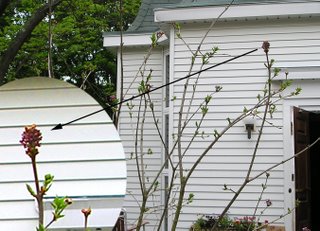 But there, right at the tip of about half the branches, were tiny blooms!
She may be nearly half a year behind her sibs across the driveway, and she may look puny to other folk, but to me she's simply gorgeous. You can be sure I spend time with her every day, still watering, and touching, and speaking words of praise to her.
She has become one of my teachers. Hang in there, no matter how hopeless you feel, she says. If you're yanked out of your comfortable home, leaving most of your roots behind, just sit tight in your new digs. New life may appear when you least expect it, and it will be all the sweeter for the surprise of it. Rough treatment certainly is no picnic, but you may find out you are tougher than you think. And don't worry too much if your neighbors seem to be more beautiful than you are; there is someone in the world who will love you to pieces, just the way you are.
I decided this plant was in the wrong place, snuggled up in the corner by the kitchen porch—not enough sun, too much wind, and stiff competition from the forsythia. So I moved it about fifteen feet west, where it could get good sun, now that ten of the twelve hemlocks once crammed into that space are gone. And when the chapel doors stand open in the summer, it would provide a lovely view. So with about half an hour to kill one afternoon, I tackled the move.
Wrong plan.
Lilac root balls are impressively large and deeply buried. Once committed, I had to get the job done, so I just got what I could of the root ball, dug the deepest hole possible (not nearly deep enough), in the remaining few minutes I had, and hoped for the best.
When this bush budded out with her parking lot neighbors in January, I was thrilled. She had made it! What stamina. But in April, when the rest of the crew was bursting with color and perfume, this little one just sat there with the same tiny buds she had produced months earlier. Uh-oh.
Every day I visited her, made sure she had enough water, checked her limbs for any sign of life, sang to her and convinced myself that there was suppleness just under my fingertips. Let's give her another week before pronouncing her past hope. Every day when I examined the little buds, I told myself something was happening there. Truth to tell, I just couldn't face the fact the I may have killed this little bush myself. Please, God, don't let me be a murderer this late in my life.
Then, a few weeks ago, there it was, the proof I had been watching and praying for all that time. No doubt about it now, there was green appearing at the bud tips. Oh, wow; we both had been reprieved.
But a few days later, I got a bigger surprise. This bush hadn't flowered in the three years since I moved here, so I assumed moving it would mean no blooms for several years more.
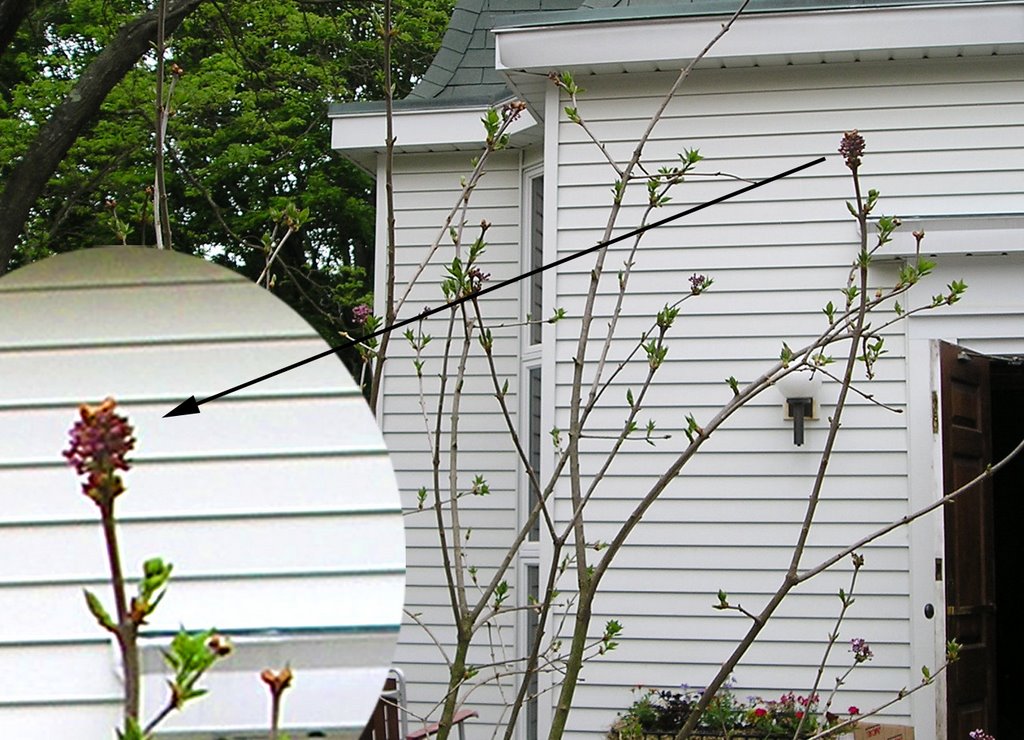 But there, right at the tip of about half the branches, were tiny blooms!
She may be nearly half a year behind her sibs across the driveway, and she may look puny to other folk, but to me she's simply gorgeous. You can be sure I spend time with her every day, still watering, and touching, and speaking words of praise to her.
She has become one of my teachers. Hang in there, no matter how hopeless you feel, she says. If you're yanked out of your comfortable home, leaving most of your roots behind, just sit tight in your new digs. New life may appear when you least expect it, and it will be all the sweeter for the surprise of it. Rough treatment certainly is no picnic, but you may find out you are tougher than you think. And don't worry too much if your neighbors seem to be more beautiful than you are; there is someone in the world who will love you to pieces, just the way you are.
Subscribe to:
Posts (Atom)

